Executive Shirts & Trousers for Corporate Uniforms — Complete Fabric Guide, Pricing & Export from India

The executive shirt and formal trouser are the backbone of corporate uniform programmes worldwide. From a Jumeirah front desk team in Dubai to a Deutsche Bank branch in Frankfurt, from Emirates cabin crew to hospital admin staff in Sydney — a well-specified shirt and matching trouser communicate authority, brand consistency, and professional standards before a single word is spoken.
Sourcing executive shirts and formal trousers in bulk from India — specifically from Tirupur’s network of specialist woven garment manufacturers — gives corporate buyers access to high-quality fabrics, precision construction, and competitive FOB pricing with reliable export to the UAE, Saudi Arabia, UK, Germany, and Australia. This guide covers everything procurement managers, HR teams, and hospitality buyers need to make the right fabric, construction, and sourcing decisions for their programme.
1. Who Orders Executive Shirts and Trousers in Bulk
The demand for executive shirts and formal trousers spans a wide range of industries. Understanding which sector you are buying for shapes every subsequent decision, from fabric choice to fit specification to customisation method.
- Hotels (front desk, F&B, management) — hotel groups represent one of the largest single buyers of executive shirt and trouser sets. Front desk associates, concierge staff, F&B supervisors, and management teams all require coordinated formal looks that uphold brand standards across every shift and every property. Large chains may outfit thousands of staff across a region from a single sourcing relationship.
- Airlines (cabin crew and ground staff) — airline uniform programmes are among the most technically demanding. Cabin crew shirts must hold a pressed appearance through 12-hour shifts, resist wrinkling under seat belt contact, and perform in both pressurised cabin environments and transit lounges. Ground staff require durable, easy-care versions. Stretch fabrics and body-mapped fits are increasingly specified.
- Banks and financial institutions — branch banking staff, relationship managers, and teller teams in markets like the UAE, Saudi Arabia, and UK increasingly wear coordinated executive uniform programmes rather than informal dress codes. A shirt in brand colours with an embroidered logo and matching trousers projects consistency across hundreds of branches.
- Real estate companies — sales associates and front-of-house staff at major real estate developers (common across the Gulf) often wear formal uniform shirts in brand colours as part of client-facing standards. Sets are typically refreshed annually.
- Government departments — civil service uniform programmes, particularly in the Gulf, specify executive shirts and formal trousers for administrative and counter staff. These orders are typically large, multi-season, and may specify Arabic labelling and regional sizing standards.
- Hospitals (admin and management staff) — while clinical staff wear scrubs or clinical tunics, hospital administration, reception, and patient services staff frequently wear formal executive shirts and trousers as part of a professional uniform programme that distinguishes them from clinical teams.
- Schools and educational institutions — teacher uniform programmes, common in private schools and international academies across the UAE, UK, and Australia, typically specify a formal shirt and trouser or skirt combination. These programmes often require OEKO-TEX certified fabrics and ethical sourcing documentation.
Each of these sectors has distinct requirements, but they share a common need: consistent quality across large volumes, reliable reorder matching, and competitive FOB pricing from a supplier with genuine export experience. For a broader overview of hospitality-specific requirements, see our hospitality uniforms guide.
2. Executive Shirt Fabric Guide
Fabric choice is the single most consequential decision in an executive shirt programme. The wrong fabric choice leads to shirts that look poor after ten washes, perform badly in climate conditions, or fail to hold a pressed appearance through a full working day. Below is a detailed breakdown of the six principal fabrics used in executive shirt manufacturing, with their performance profiles and market fit.
100% Cotton Poplin — 110–130 GSM
Cotton poplin is the reference fabric for executive shirts worldwide. Produced from a plain weave with a fine horizontal rib, poplin has a smooth, slightly sheen surface that takes well to pressing, holds a collar structure cleanly, and breathes effectively in air-conditioned office environments. At 110–130 GSM it is lightweight enough for all-day comfort without feeling flimsy. It takes reactive dyes well, producing clean, consistent colours across batches — important for uniform reorders. 100% cotton poplin requires ironing after washing, which is either a non-issue for professionally laundered corporate uniforms or a consideration for programmes where staff launder their own shirts.
Best for: Banks, hotel management, airline ground staff, government admin, school teacher uniforms. Dominant in UK and German corporate programmes.
Cotton Oxford Weave — 130–140 GSM
Oxford weave uses a basket weave construction that produces a slightly textured, more structured surface than poplin. At 130–140 GSM it is marginally heavier, giving shirts a more substantial hand feel and a look that works well for client-facing roles where a slightly less formal aesthetic is acceptable alongside the structure. Oxford is more forgiving of wrinkles than poplin and washes slightly more easily. It is particularly popular in UK corporate programmes — the fabric has a long association with British business dress — and is growing in German professional sectors.
Best for: UK corporate buyers, business hotels, real estate firms, professional services. Slightly less formal than poplin; ideal for business-casual uniform programmes.
Linen-Cotton Blend — 55% Linen / 45% Cotton
Linen-cotton blend is the premium choice for hot-climate markets. Linen’s natural hollow fibre structure allows significantly more airflow than cotton alone, making this blend the preferred fabric for UAE, Saudi Arabia, and Australian corporate programmes where staff work in heat. The 55/45 blend tempers linen’s tendency to wrinkle aggressively by combining it with the dimensional stability of cotton. The result is a fabric with natural breathability, a refined textured surface, and a slightly relaxed luxury feel appropriate for hotel management, hospitality executives, and luxury retail staff.
Best for: UAE hotel management, luxury hospitality front-of-house, Australian corporate buyers, Saudi Arabia client-facing roles. Premium tier pricing.
Poly-Cotton 60/40 — 120–135 GSM
The 60% polyester / 40% cotton blend is the workhorse fabric for large-volume corporate uniform programmes where easy care and cost efficiency are priorities. The polyester component provides wrinkle resistance, shape retention, and quick-dry performance; the cotton component adds breathability and softness. Poly-cotton shirts can be machine washed and tumble dried without ironing in many cases, making them practical for hotel rollouts where laundry cycles are high. The trade-off is a slightly synthetic hand feel compared to 100% cotton, and lower natural breathability. At 120–135 GSM it remains comfortable in air-conditioned environments.
Best for: Large hotel staff rollouts (housekeeping-adjacent roles, F&B line staff), budget-conscious government programmes, high-volume corporate programmes with in-house laundry. Most cost-effective entry point.
Bamboo-Cotton Blend — 70% Bamboo / 30% Cotton
Bamboo-cotton is the emerging sustainability choice for corporate uniform programmes in Germany and the UK. Bamboo viscose is derived from a fast-growing crop that requires no pesticides and significantly less water than cotton, making it a credible sustainability claim for companies with ESG reporting requirements or consumer-facing brand values. The fabric itself is extremely soft, has natural anti-bacterial properties, and drapes beautifully. From a performance perspective it is breathable, absorbs moisture well, and has a subtle natural sheen. It requires a gentler wash cycle than poly-cotton.
Best for: German corporate buyers (Lufthansa, Deutsche Bank sustainable programmes), UK academies and educational institutions requiring OEKO-TEX certified fabrics, brands with active sustainability commitments.
Stretch Cotton — 97% Cotton / 3% Elastane
Stretch cotton is the fabric of choice for airline cabin crew shirts and any role requiring extensive physical movement in a formal shirt. The elastane content (typically 3%) adds four-way stretch that prevents shirt pulling and bunching during activity, allows body-mapped cuts to follow the figure without restriction, and extends the garment’s lifespan by reducing stress on seams and collar areas. Stretch cotton maintains the appearance and breathability of cotton while delivering a performance that standard woven fabrics cannot match. It is more expensive to produce and requires more careful handling in cutting and finishing.
Best for: Airline cabin crew (Emirates, Etihad, Lufthansa programmes), F&B staff who are constantly moving, roles requiring a body-mapped fitted silhouette.
Shirt Fabric Comparison Table
| Fabric | Climate Suitability | Wash Care | Price Tier | Best Markets |
|---|---|---|---|---|
| Cotton Poplin 110–130 GSM | AC offices; temperate | Machine wash; iron required | Mid | UK, Germany, UAE (AC only) |
| Cotton Oxford 130–140 GSM | Temperate; AC offices | Machine wash; easy care | Mid | UK, Germany |
| Linen-Cotton 55/45 | Hot & humid; outdoor-capable | Gentle wash; iron or steam | Premium | UAE, Saudi Arabia, Australia |
| Poly-Cotton 60/40 | AC offices; versatile | Machine wash; minimal iron | Budget | All markets; volume orders |
| Bamboo-Cotton 70/30 | Temperate; breathable | Gentle wash; low heat dry | Premium | Germany, UK (ESG focus) |
| Stretch Cotton 97/3 | AC cabin; all climates | Machine wash; hang dry | Premium | Airlines; active service roles |
For market-specific executive shirt sourcing, see our dedicated pages: UAE executive shirts, Saudi Arabia executive shirts, UK executive shirts, Germany executive shirts, and Australia executive shirts.
3. Executive Trouser Fabric Guide
Formal trousers for corporate uniforms have different performance requirements from shirts. They need to hold a sharp crease through a full working day, resist bagging at the knee, drape cleanly when standing and seated, and survive frequent industrial washing without losing their pressed appearance. Below are the five key fabrics used in executive trouser manufacturing.
Poly-Viscose 65/35
The 65% polyester / 35% viscose blend is the industry standard for hotel, airline, and corporate formal trousers worldwide. Polyester provides durability, shape retention, and crease resistance; viscose (also known as rayon) provides the drape and soft hand feel that makes the fabric fall like a quality suiting fabric rather than a stiff synthetic. The result is a trouser that holds a sharp crease, drapes elegantly at the break, and resists bagging through a long shift. It washes and dries quickly, holds colour well, and is resistant to wrinkles. This is the default specification for Emirates, Marriott, Accor, and most major corporate uniform programmes globally.
Best for: Airlines, hotels, banks, government programmes. The most versatile corporate trouser fabric at mid-market pricing.
Stretch Twill — Poly-Cotton-Elastane
Stretch twill combines a poly-cotton base with a small elastane percentage (typically 2–4%) in a twill weave. The twill weave produces a diagonal rib that adds visual texture and structural rigidity, while the elastane provides give that is particularly valued by service staff who spend their shift on their feet, bending, and moving. Stretch twill trousers are increasingly specified by hotel F&B managers, ground handlers, and any role combining formal appearance requirements with physical activity. They maintain a smart appearance while significantly reducing wearer fatigue compared to rigid formal trousers.
Best for: F&B service staff, ground crew, retail floor staff, any role requiring both formal appearance and active movement.
Cotton Twill
100% cotton twill formal trousers have a long history in British and Australian corporate dress. The diagonal weave of twill gives cotton trousers more structure and crease retention than plain woven cotton, while the natural fibre provides breathability in temperate and warm climates. Cotton twill trousers require ironing but reward this care with a clean, professional appearance that feels comfortable all day. They are washable at higher temperatures than synthetic alternatives, which suits programmes where laundering standards are high. In Australia’s warmer states, cotton twill is the preferred formal trouser fabric for management and client-facing roles.
Best for: UK corporate programmes, Australian management and professional services, any programme where synthetic fabrics are not preferred.
Wool-Blend — 55% Wool / 45% Polyester
The wool-blend formal trouser represents the premium tier in corporate uniform programmes. Wool’s natural crimp gives the fabric exceptional crease recovery — a wool-blend trouser falls back into shape after sitting in a way no synthetic fabric can match. The polyester component adds washability and durability that pure wool lacks. At 55% wool the fabric retains the natural breathability and temperature-regulation properties that make wool the choice for boardroom-level uniforms. This is the fabric specified for senior management uniform programmes, luxury hotel GM and concierge teams, and premium banking environments. In Germany and Saudi Arabia, where formal dress standards are highest, wool-blend trousers are the expected specification for executive programmes.
Best for: Saudi Arabia Aramco executive programmes, Germany premium corporate buyers, luxury hotel management, boardroom-level corporate uniform programmes.
Gabardine
Gabardine is a tightly woven twill fabric made from worsted wool, cotton, or synthetic blends. Its defining characteristic is an extremely smooth, hard-wearing surface with a subtle diagonal rib that reflects light to give trousers an elegant, polished appearance. Gabardine drapes with precision, holds a crease exceptionally well, and has a durability that outlasts most other formal trouser fabrics in daily wear. It is used for formal uniform programmes where appearance standards are highest and cost is secondary to longevity and presentation. Classic airline uniform programmes — particularly in the Gulf — frequently specify gabardine for officer and cabin crew trousers.
Best for: Airline officer and senior crew uniforms, luxury hotel management, government diplomatic programmes, highest-tier corporate executive uniforms.
Formal Trouser Fabric Comparison Table
| Fabric | Market Fit | Occasion / Role | Price Tier |
|---|---|---|---|
| Poly-Viscose 65/35 | All markets; airline/hotel standard | Airline, hotel, bank counter staff | Mid |
| Stretch Twill (poly-cotton-elastane) | All markets; active service | F&B, ground crew, retail floor | Mid |
| Cotton Twill | UK, Australia | Corporate, professional services | Mid |
| Wool-Blend 55/45 | Germany, Saudi Arabia, luxury global | Boardroom, senior executive, luxury hotel management | Premium |
| Gabardine | UAE airlines, government, luxury | Airline officers, diplomatic, luxury hospitality management | Premium |
See our dedicated page on executive trousers and formal pants manufacturing for the full product range.
4. Market-by-Market Buying Guide
Executive shirt and trouser specifications vary significantly by destination market. Import duties, climate, cultural requirements, and compliance standards all differ. Here is what buyers in each of our five key export markets need to know.
UAE
The UAE is FabricCrew’s largest export market for executive uniforms. Under the India-UAE CEPA agreement, garments exported from India to the UAE attract 0% import duty — a significant saving over suppliers from non-CEPA countries who pay 5% GCC customs duty. This duty advantage compounds at scale: on a 1,000-piece executive shirt order at $10 FOB, the saving is $500 in duty alone.
For fabric, linen-cotton blend is the preferred shirt fabric for UAE-based hotel and corporate programmes given the climate. Front-of-house hospitality teams at Jumeirah, Marriott, and Rotana properties increasingly specify a silicon wash finishing treatment that gives the shirt a softened luxury hand feel appropriate for a five-star environment. For airline programmes — Emirates, Etihad — stretch cotton or premium poly-cotton with a crease-resistant finish is the dominant spec. Air freight from Tirupur to Dubai runs 5–7 days.
See the dedicated UAE executive shirt sourcing page for full details.
Saudi Arabia
Saudi Arabia’s corporate uniform market has specific requirements that differ from the broader GCC. Long-sleeve specifications are the norm for all formal shirts regardless of season — cultural and workplace norms require full sleeve coverage for both male and female admin staff. Government and corporate programmes (Aramco’s corporate employee uniform programmes are a significant buyer segment) specify shirts with Arabic-language care labels and Arabic woven brand labels as standard.
The duty rate for Indian-origin garments entering Saudi Arabia is 5% GCC customs duty (CEPA does not cover Saudi Arabia directly under the India-GCC framework at the same rate as UAE). Fabric preference leans toward cotton poplin and linen-cotton in premium corporate programmes. Delivery to Riyadh or Jeddah by air runs 6–8 days from Tirupur. See the Saudi Arabia executive shirt page for full details.
UK
The UK corporate uniform market is one of the most specification-conscious in the world. Post-Brexit, garments entering the UK from India attract a 12% import duty under MFN tariff rates (the UK-India Free Trade Agreement, once ratified, is expected to reduce this significantly). Despite this, India’s fabric quality and FOB pricing continue to make Indian-origin executive shirts and trousers highly competitive in the UK market.
Oxford weave shirts have a strong cultural fit in the UK corporate market. Slim fit is the dominant cut for urban professional and banking uniforms. OEKO-TEX Standard 100 certification is increasingly required by UK educational institutions and companies with ESG commitments. Bamboo-cotton blends are growing in popularity among UK buyers looking to meet sustainability targets. For academy and school teacher uniform programmes, OEKO-TEX certification and documented supply chain traceability are often prerequisites. See our UK executive shirt sourcing page.
Germany
Germany’s corporate uniform market is characterised by high compliance standards and strong sustainability orientation. REACH regulation compliance and OEKO-TEX Standard 100 certification are effectively mandatory for garments entering the German market — buyers at the Lufthansa, Deutsche Bank, and BMW supplier programme level will ask for these certificates as a condition of order. Bamboo-cotton shirts and eco-processed fabrics are not just a premium option in Germany but an increasingly standard expectation.
Germany also has one of Europe’s strongest corporate sustainability reporting requirements (under the German Supply Chain Due Diligence Act / LkSG), which means corporate buyers need documented supplier audits and ethical production standards. FabricCrew’s partner factories are audited and can provide the documentation German buyers require. See the Germany executive shirt sourcing page for compliance details.
Australia
Australia’s hot climate in most major business centres makes linen-cotton blend the leading executive shirt fabric, particularly in Queensland, Western Australia, and the Northern Territory. Sydney and Melbourne support a wider range including cotton poplin and Oxford weave for more temperate conditions. The ECTA (ASEAN-Australia-New Zealand Free Trade Agreement) does not directly cover India, but the Australia-India ECTA (signed 2022) provides tariff concessions on garments, making Indian-origin executive uniforms competitive versus competitors from non-FTA countries.
Australia’s mining and resources sector — with management shirt programmes at BHP, Rio Tinto, Fortescue, and their contractor base — represents a significant volume buyer for executive shirts and trousers. Management staff in these organisations wear formal shirts as part of their office and site visit dress code. See the Australia executive shirt page for full details.
5. Coordinated Shirt and Trouser Sets
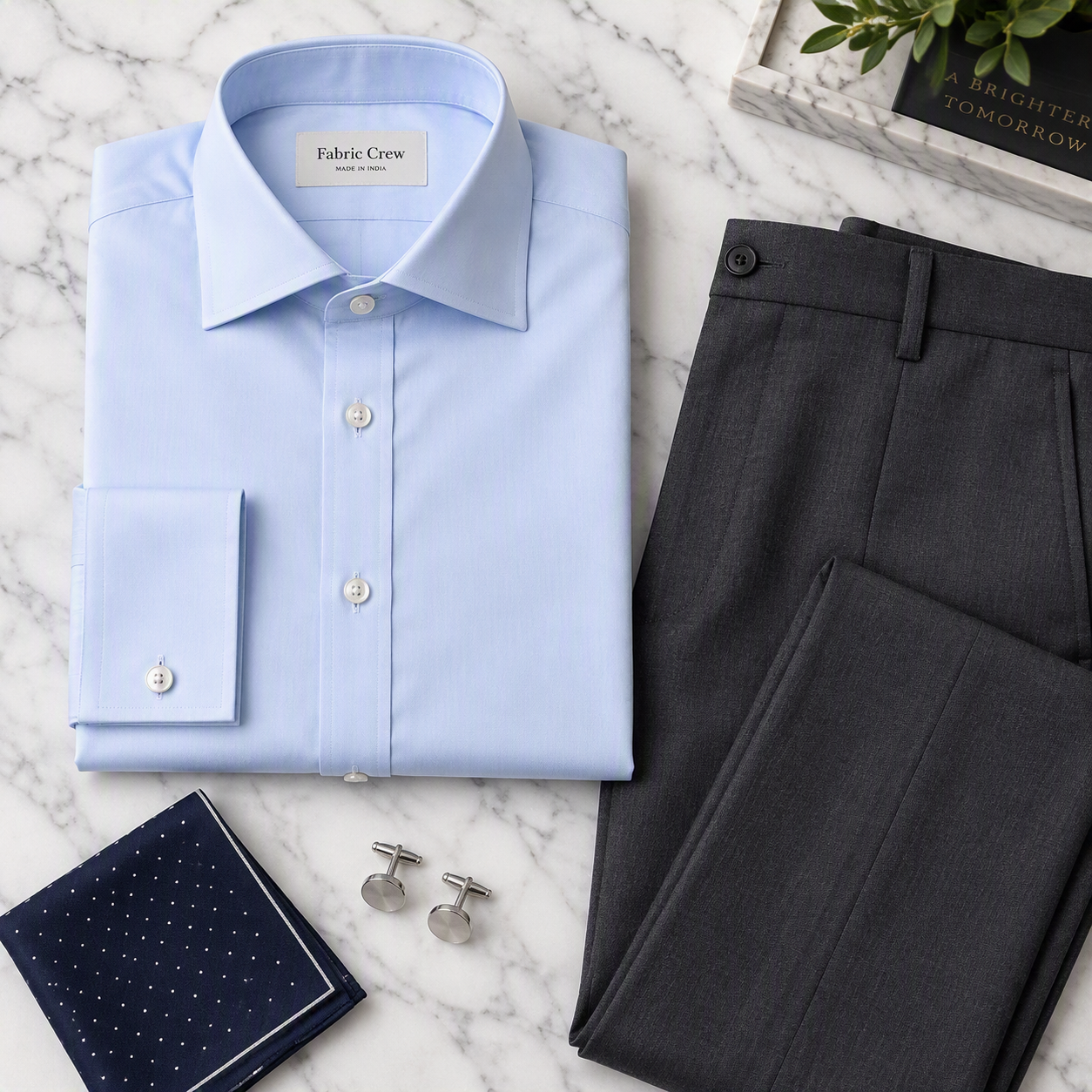
Airlines and hotel groups almost universally order executive shirts and formal trousers as coordinated sets rather than as separate garment categories. The reason is colour matching: when a shirt and trouser are produced from different dye batches — even with the same Pantone reference — they may appear subtly different under certain lighting conditions, particularly the warm artificial lighting of hotel lobbies and aircraft cabins.
Managing colour consistency across two different garment types and two different fabric constructions is one of the most technically demanding aspects of executive uniform production. FabricCrew handles this through the following process:
- Single dye lot commitment — wherever possible, the shirt fabric and trouser fabric are dyed in the same production lot using the same dye formula, ensuring visual consistency from the outset.
- Lab dip approval — before bulk production, lab dips (small fabric samples dyed to the target colour) are produced for both shirt and trouser fabric and presented together for buyer approval under controlled lighting conditions.
- Dye lot records retained — FabricCrew retains the dye lot reference and formula for every bulk order. This allows precise colour matching on reorders even 12–18 months after the original production run.
- Set packaging — coordinated shirt and trouser sets can be polybag-packed as matched pairs at the production stage, simplifying hotel onboarding and staff allocation.
Ordering shirts and trousers together from a single sourcing coordinator eliminates the colour drift that frequently occurs when these garments are sourced separately from different suppliers. It also simplifies logistics — one shipment, one set of export documents, one freight booking.
6. Construction Quality Checklist
Not all executive shirts and formal trousers are built to the same standard. The difference between a $6.50 and a $12.00 executive shirt is not just fabric; it is in the construction details that determine how the garment looks and performs over time. Here is what separates premium from budget construction:
Executive Shirt Construction Standards
- Fused vs sewn collar interlining — budget shirts use a fused (glued) interlining in the collar that can bubble and delaminate after 20–30 washes. Premium shirts use a woven sewn interlining that maintains collar structure through hundreds of wash cycles. This is the single most visible quality difference between shirt tiers after prolonged use.
- Mother-of-pearl vs plastic buttons — plastic buttons are functional but cheap-looking. Real or synthetic mother-of-pearl buttons have a subtle lustre and a weight that reads as quality. For hotel management, airline crew, and premium corporate programmes, the button specification matters.
- French seams vs overlocked seams — French seams fold the raw edge inside the seam and enclose it, producing a clean finish on the inside of the shirt that prevents fraying and extends garment life. Overlocked seams are faster to produce but visible on the inside; they are acceptable for budget shirts but not for premium programmes.
- Double-needle stitching — double-needle stitching on the hem and cuffs produces a parallel stitch line that is significantly stronger than single-needle and adds a visible quality signal. Look for 10–12 stitches per inch as a quality benchmark.
- Compacting finish — a mechanical compacting (sanforising) process applied to the fabric before cutting reduces post-wash shrinkage. Without this, even quality shirts can shrink unevenly, pulling at the collar or shortening the body over time. This is particularly important for hotel uniform programmes where shirts are washed industrially at high temperatures.
- Placket construction — a clean, straight placket with even button spacing is a construction quality indicator. A sewn-through placket (where the interlining is stitched through all layers) is more durable than a glued placket and maintains its flat appearance longer.
Formal Trouser Construction Standards
- Waistband canvas — a woven canvas interlining in the waistband maintains its shape through repeated wearing and washing. Glued or fused waistbands lose their structure quickly under industrial laundry conditions.
- Crease-set finishing — the front crease of a formal trouser should be set during finishing using a pressing process that ensures the crease holds through normal wearing. On premium trousers this is reinforced with a crease-setting agent applied during finishing.
- Seat and knee lining — a partial lining at the seat and knee reduces bagging, extends garment life, and improves comfort during extended sitting.
- Bar tacking at stress points — pocket corners, fly top, and waistband join points should be bar-tacked to prevent tearing at the points of highest stress.
When requesting samples, inspect all of these points before signing off on bulk production. A physical sample review is the most effective quality control tool available to buyers.
7. Customisation Options
Executive shirts and formal trousers can be customised at multiple levels to reflect brand identity, organisational hierarchy, and individual employee personalisation. FabricCrew supports the following customisation methods:
- Embroidered logo — the standard branding method for executive shirts. A digitised embroidery file of your logo is stitched directly onto the left chest, sleeve, or collar. Embroidery survives industrial washing without degradation and looks premium on any shirt fabric. Minimum embroidery area for clean results is approximately 3–4 cm wide for logos with fine detail.
- Monogramming — individual staff initials embroidered on the cuff or collar are standard in luxury hotel management programmes and airline officer uniforms. Available in a range of embroidery thread colours and typefaces.
- Woven label — a custom woven label with your brand name or logo sewn inside the collar adds a premium interior finish. Common in luxury hotel management uniforms, airline officer programmes, and premium corporate sets. Available in satin, damask, and taffeta weave.
- Custom buttons — buttons can be custom-dyed to a brand colour, embossed with a logo, or specified in a non-standard material (resin, natural shell, metal). Custom buttons have a minimum lead time and setup cost but add a distinctive brand detail to high-visibility shirts.
- Sleeve length options — standard long sleeve, short sleeve, and three-quarter sleeve options are available. For Saudi Arabia and conservative market programmes, long sleeve is standard; for Australian and some UK programmes, short sleeve variants are frequently ordered for warm weather.
- Women’s fitted versions — all executive shirt styles are available in women’s fitted cuts with shaped waist and hip allowance. Women’s formal trousers are available in tapered and straight leg options with a fully-adjustable waistband option. Size ranges from XS to 3XL. Women’s and men’s shirts and trousers from the same order are produced in the same colour lot to ensure visual consistency across the team.
8. Pricing Guide
The following pricing is based on FOB Tirupur 2026 rates. Air freight to your destination is in addition to these prices. Volume discounts apply at 300+ and 500+ pieces per style.
| Item | MOQ | Price Range (FOB Tirupur) |
|---|---|---|
| Cotton poplin executive shirt (embroidered logo) | 50 pcs | $6.50–$8.00 / pc |
| Premium linen-cotton executive shirt | 50 pcs | $9.00–$12.00 / pc |
| Bamboo-cotton shirt (OEKO-TEX certified) | 50 pcs | $10.00–$13.00 / pc |
| Stretch cotton airline crew shirt | 50 pcs | $11.00–$14.00 / pc |
| Basic poly-viscose formal trouser | 50 pcs | $7.50–$9.50 / pc |
| Stretch twill formal trouser | 50 pcs | $9.00–$11.50 / pc |
| Wool-blend premium formal trouser | 50 pcs | $14.00–$18.00 / pc |
| Coordinated shirt + trouser set | 50 sets | 10% discount vs individual pricing |
These are indicative FOB prices. Final pricing depends on fabric specification, GSM, embroidery complexity, and total order volume. Orders above 300 pieces per style receive further volume pricing. Air freight to UAE and Saudi Arabia typically adds $1.50–$2.50 per kilogram; to UK and Germany $2.00–$3.50 per kilogram depending on carrier and total shipment weight. Request a quote for a precise costing for your programme.
9. Frequently Asked Questions
What is the minimum order quantity for executive shirts and formal trousers?
The minimum order quantity is 100 pieces per style and colour for both executive shirts and formal trousers. Coordinated shirt and trouser sets can be ordered at 50 sets MOQ, and ordering both shirt and trouser together qualifies for a 10% set discount on the combined per-unit price.
Can you match the shirt and trouser colour exactly when ordering as a coordinated set?
Yes. FabricCrew manages dye lot consistency across both garment types in a coordinated set order. The shirt fabric and trouser fabric are dyed using the same dye formula, lab dip approval is carried out on both fabrics together, and dye lot records are retained for future reorder matching. This eliminates the colour drift that occurs when shirts and trousers are sourced from different suppliers.
What is the lead time from order to delivery?
Standard lead time from order confirmation and sample approval to delivery is 4 to 5 weeks. This includes sample production (7–10 days), bulk production (18–22 days), and air freight to your destination (5–7 days to UAE/Saudi Arabia; 7–10 days to UK, Germany, and Australia). Rush production at a premium is available for urgent orders.
What size range is available?
Executive shirts are available from XS through 4XL in standard fit, slim fit, and regular fit. Formal trousers are available in waist sizes 28 to 48 inches with standard, short, and long inseam options. Women’s fitted shirts and trousers are also available in XS to 3XL with bespoke sizing available for larger programmes.
Are women’s fitted executive shirts available?
Yes. Women’s fitted executive shirts are available in all the same fabric options as men’s styles, cut with a shaped waist and hip allowance. Women’s formal trousers with tapered and straight leg options are available as matching sets. Men’s and women’s garments from the same programme are produced in the same dye lot to ensure visual consistency across the full team.