Garment Manufacturers in India Looking for Export Orders — How to Get Started and Grow
India is one of the world’s largest apparel manufacturing countries, yet a significant portion of its manufacturing capacity goes underutilised. Small and medium garment factories across Tirupur, Ludhiana, Surat, Delhi NCR, and other textile clusters often produce excellent quality garments but struggle to connect with international buyers consistently. If you are a manufacturer or supplier in India looking for regular export orders, this guide is for you.
We will cover how export sourcing works, what international buyers expect, what you need to be export-ready, which products are in demand, and how you can join Fabric Crew’s verified supplier network to access orders directly.
The Opportunity: What International Buyers Are Sourcing from India
International buyers — from corporate uniform companies in the UAE, to security uniform suppliers in the USA, to fashion brands in the UK and Germany — are actively sourcing from India. The common thread is value: India offers a combination of quality, customisation capability, and pricing that is difficult to match elsewhere.
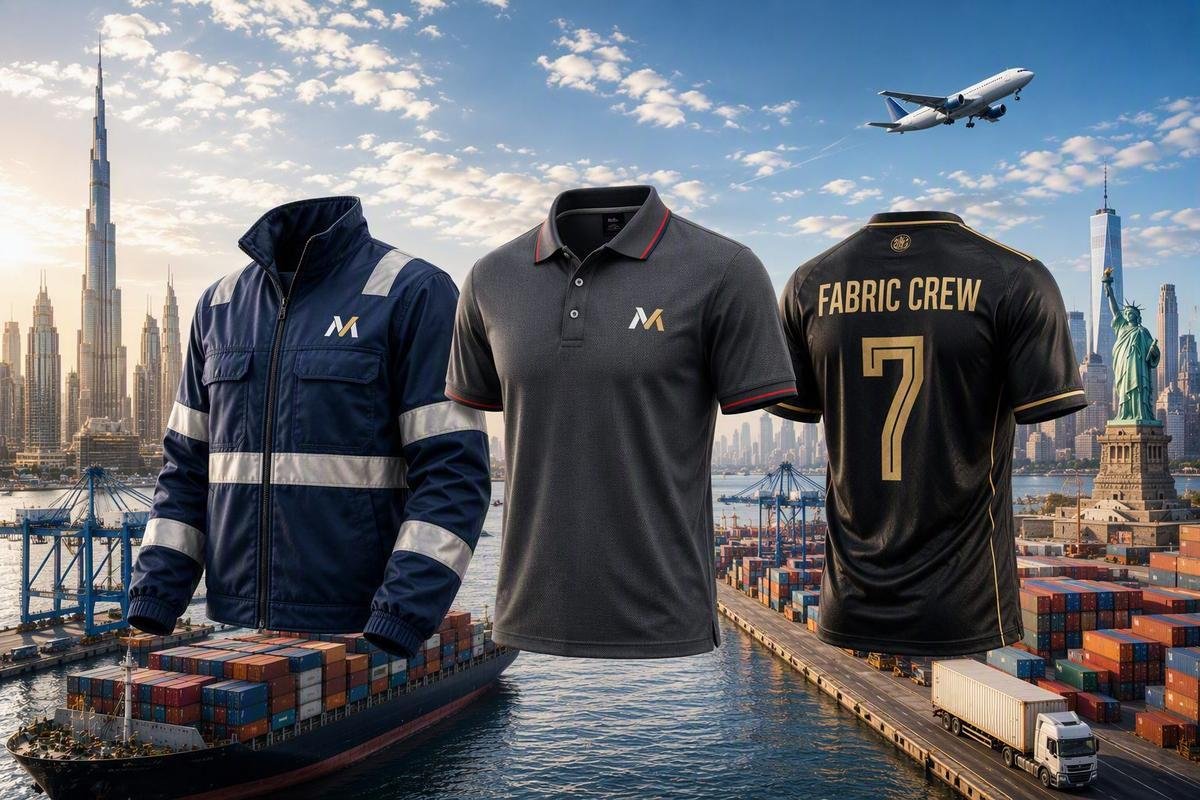
The products most actively sourced from Indian manufacturers by international buyers include:
- Polo shirts and T-shirts: The single largest category. Cotton pique polo, sublimation polyester, cotton-polyester blend. Buyers in UAE, Saudi Arabia, Australia, UK, and USA place regular orders.
- Corporate and staff uniforms: Formal shirts, formal trousers, cargo pants, and matching sets for hotels, hospitals, airlines, and office environments. UAE and Gulf region buyers are among the most active.
- Security and tactical uniforms: Woven shirts with patches, epaulettes, and embroidery. Buyers in USA, UK, and Middle East. This segment has higher customisation requirements but also higher margins.
- Medical scrubs: Growing segment. UK, USA, and Gulf healthcare providers are sourcing scrubs, tunics, and theatre wear from Indian manufacturers at scale.
- Activewear and sportswear: Football jerseys, cricket kits, basketball uniforms, gym wear. Sublimation printing capability is key. Buyers from UK, Australia, Europe, and South Africa.
- Hoodies and fleece: Promotional and branded hoodies. UK and European buyers order heavily, especially September to February.
- Hospitality uniforms: Resort shirts, linen garments, F&B uniforms. Maldives, UAE, and Southeast Asian resort buyers. Linen and linen-blend capability is particularly valued.
- Woven shirts and trousers: Formal and semi-formal woven garments. Year-round demand from buyers who want an alternative to Bangladesh and China.
Why Indian Manufacturers Struggle to Get Export Orders Directly
The challenge is not manufacturing capability — most mid-size Indian factories produce to a standard that international buyers would accept. The real barriers are:
1. International Marketing and Lead Generation
Finding international buyers requires consistent marketing presence — a credible website, international trade fair participation, listing management on B2B platforms, and outbound sales. Most factory owners are production-focused and do not have the time, budget, or skills to maintain this consistently.
2. Communication and Documentation
International buyers expect fast, professional communication in English. They expect detailed quotations, tech pack responses, proforma invoices, commercial invoices, packing lists, and certificates of origin delivered correctly and on time. Gaps in documentation are a common reason buyers drop small suppliers even when product quality is good.
3. Export Compliance and Paperwork
IEC registration, GST LUT, FIRC reconciliation, Customs Shipping Bills, eBRC (Electronic Bank Realisation Certificate) — these are all part of the export process. Manufacturers new to exports often find the paperwork burden significant.
4. Trust and Verification
International buyers cannot physically visit every supplier. They work with manufacturers they have been able to verify through samples, references, audits, or sourcing intermediaries. A new manufacturer with no international track record faces a credibility gap regardless of actual capability.
5. MOQ Mismatches
Many small Indian factories quote MOQs of 500 or 1,000 pieces per colour because that is what they are used to for domestic orders. International buyers — especially first orders — often want 50 to 200 pieces as a pilot. Factories that refuse small pilot orders lose the chance to build a long-term relationship.
What Fabric Crew Does and How Suppliers Fit In
Fabric Crew is a custom apparel sourcing coordinator based in Tirupur, Tamil Nadu. We receive enquiries and orders from international buyers — corporate companies, security agencies, hospitality groups, sports teams, NGOs, promotional agencies — in countries including the UAE, USA, UK, Germany, South Africa, Australia, and more.
We do not own a factory. Instead, we work with a network of verified manufacturers across India who have the capability to produce specific product types to the standard our buyers expect. When we receive an order, we match it to the right supplier in our network, coordinate the production, manage the documentation, and ensure the shipment reaches the buyer correctly.
This model works well for both sides:
- For the buyer: They deal with one professional point of contact for sourcing, communication, and documentation. They do not need to manage multiple factory relationships.
- For the manufacturer: They receive orders that match their capability without having to invest in international sales and marketing. They focus on what they do best — manufacturing.
What Types of Manufacturers We Are Looking For
We are actively looking to expand our verified supplier network across India. The product categories where we have regular or upcoming demand:
Knitwear Manufacturers — Tirupur and Tamil Nadu
Polo shirts, round neck T-shirts, and corporate knitwear in cotton, polyester-cotton, cotton-viscose, and cotton-lycra. Machines should be capable of 140 GSM to 260 GSM fabric weights. Embroidery capability (in-house or through a reliable job worker) is a strong advantage. Bio-wash finishing capability preferred for premium orders.
Woven Garment Manufacturers — Delhi NCR, Faridabad, Gurgaon, Ludhiana
Formal shirts, cargo pants, security shirts, and corporate trousers. Experience with interlining, epaulette construction, pocket designs, and multi-position embroidery. Buyers in the security uniform and corporate uniform space frequently require very precise construction to tech pack specifications.
Medical Scrub and Healthcare Garment Manufacturers — Any Location
Medical scrub tops and bottoms, nurse tunics, doctor coats, theatre wear. Cotton or cotton-polyester blend. This is a growing category with buyers from UK NHS supply chains and private healthcare providers in the Gulf. Manufacturers with experience in this segment are particularly welcome.
Activewear and Sublimation Jersey Manufacturers — Tirupur and Mumbai
Sublimation football jerseys, cricket kits, basketball uniforms, running gear, gym wear. Full-cut-and-sew capability with in-house or reliable outsourced sublimation printing. Buyers from UK club teams, Australian sports associations, and USA team sports supply chains.
Hospitality and Linen Garment Manufacturers
Resort shirts, linen kurtas modified for hospitality staff, F&B aprons, housekeeping uniforms. Experience working with linen, linen-cotton, and rayon-linen blends. Buyers from Maldives resort operators, UAE hotel groups, and Southeast Asian hospitality chains.
Accessories Manufacturers — Hats, Bags, Belts, Socks
Branded caps and hats, tote bags and backpacks, belts, socks, and safety footwear. Many corporate uniform orders include accessories alongside garments — having accessory suppliers in our network allows us to fulfil complete uniform packages for buyers.
What We Expect from Suppliers in Our Network
Being part of the Fabric Crew supplier network is not just a listing — it is a working relationship. We set clear expectations upfront so there are no surprises:
Quality Consistency
International buyers do not tolerate inconsistency between orders. If your first shipment passes quality and the second does not, the buyer relationship ends — and so does our relationship with you. We require suppliers to maintain consistent GSM, construction, and finish across orders. In-process quality checks at cutting, stitching, and finishing stages are expected.
Honest Capability Communication
Tell us exactly what you can and cannot do. If you cannot produce below 200 pieces, say so. If you do not have in-house embroidery, say so. We would rather know upfront and find the right match than have a production problem mid-order. Overselling capability is the fastest way to lose trust in this business.
Lead Time Adherence
Export shipments are linked to buyer deadlines. A delay at the production end causes missed air or sea bookings, which causes customer problems at the buyer’s end. We expect the lead time you quote to be the lead time you deliver. If there is a genuine issue, communicate early — not two days before the ship date.
Export Documentation Support
You will need to provide commercial invoices, packing lists, and occasionally certificates of origin and test reports. If you are new to exports, we will guide you through the process — but the commitment to paperwork accuracy is yours.
Pilot Order Willingness
New buyers almost always place a pilot order before committing to scale. We expect our suppliers to be willing to produce pilot quantities of 50 to 100 pieces at a reasonable price. This is how trust is built and how repeat orders begin.
What You Get by Joining the Network
- Direct order referrals: When we receive an order matching your capability, we contact you first before looking elsewhere.
- International buyer access: Orders from UAE, UK, USA, Germany, Australia, South Africa, and more — markets you would otherwise need a significant sales investment to reach.
- Support on documentation: We help you prepare and present export documents correctly, especially for first-time exporters.
- Best practice guidance: Our standards are aligned with what international buyers expect. Working with us means your team gets exposure to international quality expectations, tech pack reading, and communication standards — skills that compound in value over time.
- No upfront cost: Registration is free. We charge no listing fee or subscription. We earn on the orders we bring you.
- Long-term relationship: We are not a one-order platform. Our model is built on repeat business. When we find a manufacturer who delivers consistently, we protect that relationship and grow order volumes together.
Getting Export-Ready: What You Need Before Your First Export Order
If you have not exported before, here is what to sort out before you can accept an international order:
IEC — Importer Exporter Code
Mandatory for any export from India. Apply online at the DGFT portal (dgft.gov.in). Processing is usually 1–2 working days. You need a PAN card and a bank account in the company name.
GST Registration and LUT
If you are already GST-registered, apply for a Letter of Undertaking (LUT) on the GST portal. LUT allows you to export without paying IGST — you effectively export at zero GST. Without LUT, you would pay GST and then claim a refund, which creates cash flow problems. LUT is renewed annually and takes a day or two to process.
Bank Account for FIRC
Export payments come in as foreign currency. Your bank will convert and credit, and issue a FIRC (Foreign Inward Remittance Certificate) or eBRC (Electronic Bank Realisation Certificate). These are important for GST and income tax purposes. Ensure your bank account is export-transaction-enabled.
Shipping and Freight Knowledge
You do not need to manage freight yourself — most export orders are quoted FOB (Free On Board), meaning your responsibility ends when the goods are handed to the freight forwarder at the origin port or airport. Knowing local freight forwarders in your city who handle DHL/FedEx air shipments and sea LCL (Less than Container Load) bookings is useful.
Commercial Invoice and Packing List Format
Export invoices must include: exporter and importer details, HS/HSN code of the product, description, quantity, unit price, total value in foreign currency, country of origin, and shipping terms (FOB/CIF). Your bank and freight forwarder will guide you on format if needed.
Manufacturing Hubs Across India — Where Are You Located?
India’s garment manufacturing is clustered in specific cities and regions. Here is a quick reference for what each hub specialises in, and how it fits with export orders:
Tirupur, Tamil Nadu
India’s knitwear capital. Over 8,000 manufacturing units, 55–60% of India’s knitwear exports. Polo shirts, T-shirts, hoodies, and sportswear are the core products. If you are in Tirupur, you are already in the most export-active apparel cluster in the country. Demand for corporate polo shirts, sublimation jerseys, and uniform knitwear is consistent year-round from our buyers.
Ludhiana, Punjab
Strong in knitwear, winterwear, and synthetic garments. Hoodies, sweatshirts, thermal innerwear, and fleece products. European and North American buyers active in this space. If your unit in Ludhiana does knitwear with export quality finish, we want to know about you.
Surat, Gujarat
Surat is India’s largest synthetic textile hub. Saree and dress material primarily, but an increasing number of units are producing woven garments, polyester uniforms, and synthetic activewear for export. Sublimation printing is well-established in Surat. Sportswear and activewear manufacturers here can serve our sportswear buyer segment.
Delhi NCR — Okhla, Noida, Faridabad, Gurgaon
Large base of woven garment manufacturers producing formal shirts, trousers, uniforms, and corporate wear. A significant number of export-oriented units already operate here. Security uniform manufacturers and corporate uniform factories in Delhi NCR are a priority category for us given the demand from UAE, UK, and USA buyers.
Mumbai and Bhiwandi
Strong in fabric sourcing and finishing, with garment units across the region. Denim, casual wear, and fashion garments are the core. Some activewear units are also present. Mumbai-based manufacturers often have good export experience given the city’s long trading history.
Chennai and Kancheepuram
Silk and traditional textiles aside, Chennai has a growing cluster of garment exporters in the north and south of the city. Proximity to Tirupur means manufacturers here can access Tirupur’s fabric and accessories ecosystem. Woven garment and uniform manufacturers in Chennai are welcome in our network.
Bangalore
Home to several large integrated garment manufacturers, many with existing international brand relationships. Smaller units also operate in and around the city. Activewear, sportswear, and premium woven garments. Manufacturers looking for additional order volume — beyond their existing buyer base — can benefit from our network.
Common Questions from Manufacturers Considering Export
Our MOQ is 1000 pieces. Can we still export?
Yes, but you may need to be flexible on pilot orders. International buyers typically want a pilot of 50–200 pieces before committing to 500+. The usual approach is to price the pilot at a slightly higher rate to account for the small quantity cost, and then move to your standard MOQ from the second or third order. Refusing all orders below your MOQ means you never build the relationship that leads to large repeat orders.
We have never exported before. Is it very complicated?
The first export is the most work. IEC, LUT, learning the invoice format, coordinating with a freight forwarder for the first time — these are all one-time learning curves. After the first shipment, the process becomes routine. Fabric Crew will guide you through documentation on your first order if you are new to exports.
What currency will we be paid in?
Typically USD for UAE, USA, and most international orders. GBP for UK orders occasionally. Payment is received via TT (Telegraphic Transfer / bank wire) directly to your bank account. The bank converts at the prevailing rate and issues your FIRC/eBRC. Standard terms are 50% advance and 50% before shipment for new relationships.
Do we need special certifications for export?
For most general garment exports, IEC and GST LUT are sufficient. Buyers in regulated markets (UK, EU, USA) may ask for specific certifications depending on the product — OEKO-TEX for chemical safety, GOTS for organic claims, SA8000 for social compliance audits. If a buyer requires a specific certification you do not have, we will tell you in advance so you can decide whether to pursue the order.
How does pricing work for export orders?
Export orders are typically quoted FOB (Free On Board) from your nearest port or airport. This means your price includes manufacturing, labelling, packaging, and inland transport to the freight forwarder. The buyer or their agent handles freight and import duty in the destination country. Pricing should account for your production cost, overhead, and margin — and should be quoted in USD to the buyer.
Ready to Register? Here’s What Happens Next
If you are a garment manufacturer, apparel supplier, or accessories manufacturer in India and you are looking for regular export orders or want to explore export for the first time, we invite you to register with Fabric Crew’s verified supplier network.
The process is simple:
- Fill in your details and capabilities on our supplier registration form — it takes 2 minutes
- Our team reviews your profile and contacts you to verify and introduce ourselves
- Once verified, you are added to our active supplier network
- When we receive an order matching your capability, we reach out to you directly with full order details
- You quote, we confirm with the buyer, and production begins
There is no fee to register. There is no subscription. We earn only when we successfully place orders with you.
Are You a Garment Manufacturer in India?
Register with Fabric Crew’s verified supplier network. Get matched to regular export orders from UAE, UK, USA and more. Free registration. No middlemen.
Register as a Supplier →Polo shirts • Uniforms • Activewear • Woven Garments • Accessories
A Note on Quality Standards and Best Practices
International buyers have a different expectation set than domestic buyers. They expect:
- Accurate shade matching: Lab dip approval before bulk dyeing. Buyers will not accept shipments with shade variation from the approved sample.
- Consistent GSM: Fabric weight variance of more than ±5% is typically rejected. Weigh your fabric before cutting every lot.
- Stitch density: Minimum 10–12 stitches per inch for most garments. Seam strength matters for garments worn in physically demanding environments (workwear, security, activewear).
- Accurate measurements: POM (Points of Measurement) from the buyer’s tech pack must be met within the stated tolerance. Measurement deviations are a common cause of rejections.
- Correct labelling: Country of origin label, care label, and fibre content label are typically mandatory. Labels must be sewn, not printed, for most markets.
- Packaging standards: Individual poly-bagging, size stickers, assortment per carton as specified by the buyer. Do not substitute packaging material without informing the buyer.
Working with Fabric Crew means adopting these standards. We will share specific quality guidelines for each order, and we are available to support you in understanding what international buyers expect. Over time, manufacturers in our network who consistently meet these standards receive more orders and are offered preferred supplier status.
Final Word
India has world-class garment manufacturing capability. The gap between manufacturing quality and international order access is a marketing and communication gap — not a production gap. Fabric Crew bridges that gap. If you make good garments and want to reach buyers who will pay you fairly and order regularly, register with us. We are building a network of manufacturers we can trust and grow with, and we are looking for suppliers who share that ambition.