Custom Sports Uniforms: Complete Buying Guide 2026
Whether you are kitting out a local cricket club, a competitive football academy, a school sports team, or a national-level league, ordering custom sports uniforms involves more decisions than most first-time buyers expect. This guide covers everything: fabric choice, printing methods, sizing, MOQ, pricing, lead times, and how to avoid the most common mistakes. By the end, you will know exactly what to ask for and what to watch out for.
Step 1: Define Your Sport and Garment Type
Different sports have fundamentally different uniform requirements. Before you contact any manufacturer, you need to be specific:
Cricket Uniforms
A standard cricket uniform set typically includes a jersey (with or without collar), trousers, and optionally a training t-shirt. Most modern cricket kits use sublimation printing on 100% polyester fabric for the jersey. Trousers are typically white or cream polyester-cotton for test cricket, or coloured polyester for limited-overs and T20 formats.
Football / Soccer Uniforms
Custom football kits typically consist of a jersey, shorts, and optionally socks. All-over sublimation is standard for club-level and above. The fabric is typically lightweight polyester mesh (150–160 GSM) for breathability. Individual player names and numbers are almost always required.
Basketball Uniforms
Basketball uniform sets include a reversible or non-reversible jersey and matching shorts. Reversible uniforms (one side home, one side away) are popular because they halve the per-player kit cost for clubs with home-and-away requirements. Polyester mesh or dri-fit fabric is standard.
Other Sports
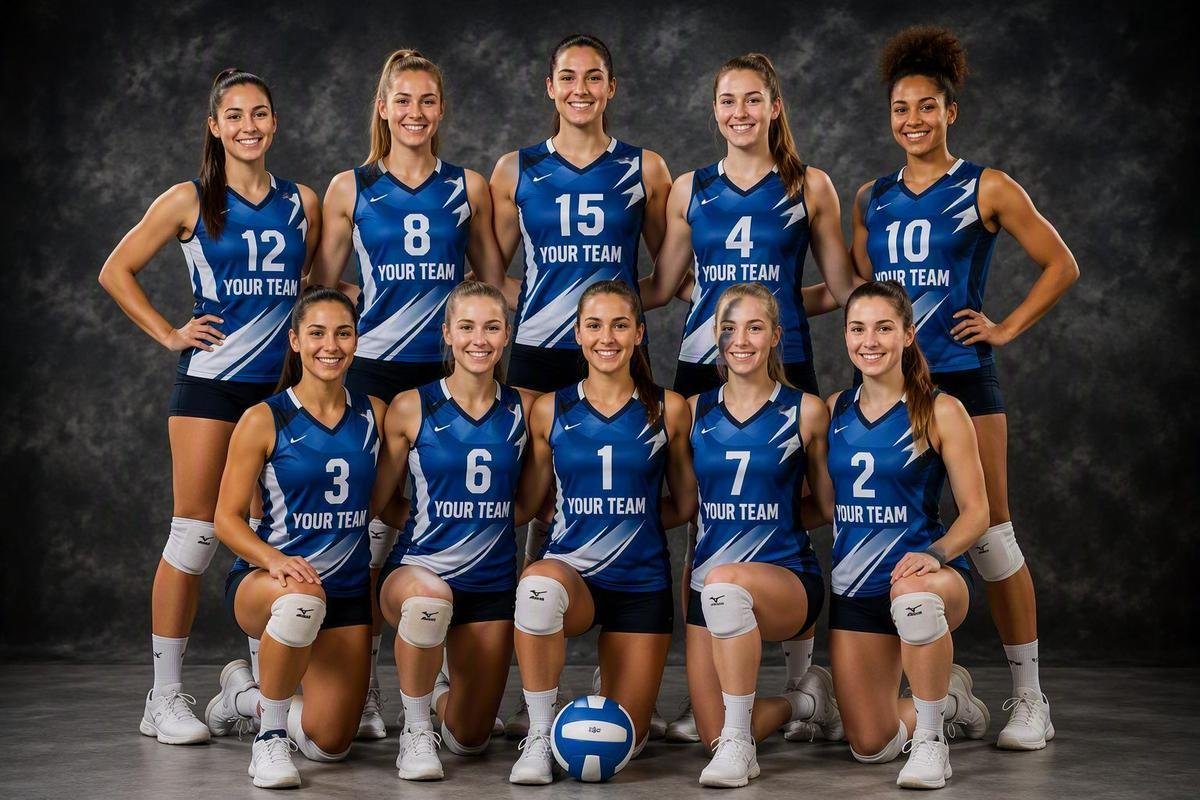
Badminton, volleyball, kabaddi, athletics, and cycling all have specific cut and fabric requirements. The key question is always: what are the physical demands of the sport, and what fabric performance does the athlete need? Moisture wicking and stretch are the two most common requirements across all sports.
Step 2: Choose the Right Fabric
Fabric choice is the single most impactful decision for performance and durability. Here is a practical guide:
100% Polyester
The standard for sublimation sports uniforms. Lightweight (130–160 GSM), excellent moisture management, quick-drying, and compatible with the sublimation printing process. Available in plain, birdseye mesh, honeycomb, and interlock weaves. Best for: football, cricket, basketball, badminton, volleyball.
Polyester-Spandex (4-Way Stretch)
Adds 5–10% spandex to polyester for a compression or fitted look with full range of motion. Used in cycling kits, athletics singlets, and close-fit performance tops. Slightly higher cost than plain polyester but the stretch benefit is real for body-contact sports.
Polyester-Cotton Blend
Softer against skin than 100% polyester. Less moisture management performance. Used for training t-shirts and casual team wear rather than match uniforms. If comfort over performance is the priority, a 65:35 or 60:40 polyester-cotton blend is a good choice.
GSM Guide
- 130–150 GSM: Lightweight match wear, suitable for warm/hot climates
- 160–180 GSM: Mid-weight, good for training wear and temperate climates
- 200+ GSM: Heavier weight, used for cold-weather training tops and outerwear
Step 3: Select Your Printing Method
The two main options for custom sports uniforms are sublimation and screen printing. The full comparison is covered in our Sublimation vs Screen Printing guide, but the short answer for sports uniforms is:
- Sublimation: Best for all-over designs, multiple colours, gradients, and individual name/number personalisation. Permanent, never cracks or peels. Works on white or light polyester only.
- Screen printing: Best for simple 1–3 colour logos on existing blank garments. Excellent for cotton or cotton-blend fabrics. Can crack with repeated washing on stretch fabrics.
For team sports uniforms that will see regular match use and repeated washing, sublimation is the recommended default.
Step 4: Plan Your Size Ratio
This is where many first-time buyers make mistakes. You need to collect actual size data from your team before placing an order. A typical adult team size distribution looks something like:
- XS: 5% of total
- S: 15%
- M: 30%
- L: 30%
- XL: 15%
- XXL: 5%
However, this varies significantly by sport, region, and age group. Youth teams will have a very different distribution from adult clubs. Always confirm sizes with players before ordering — receiving the wrong sizes is costly and often unresolvable. For a full guide on planning size ratios and MOQ, see our MOQ guide.
Step 5: Understand MOQ and Pricing
For custom sports uniforms from an Indian manufacturer like Fabric Crew, typical pricing and MOQ ranges are:
| Product | MOQ | Price Range (FOB) |
|---|---|---|
| Sublimation football jersey | 50 pcs | $4.50–$8.00 |
| Cricket jersey (collar) | 50 pcs | $5.00–$9.00 |
| Basketball reversible set | 50 pcs | $7.00–$12.00 |
| Full football kit (jersey + shorts) | 50 pcs | $8.00–$15.00 |
| Training t-shirt (screen print) | 100 pcs | $3.50–$6.00 |
These are FOB (Free on Board) prices from Tirupur. Add air freight (typically $1.00–$2.50 per piece for small orders), import duty (check the applicable HTS code for your country), and any courier handling charges for the full landed cost.
Step 6: Allow the Right Lead Time
Custom sports uniform production from India typically follows this timeline:
- Quote and brief confirmation: 1–2 days
- Design proof / virtual mockup: 2–3 days
- Physical sample production and shipping: 7–14 days
- Sample review and approval: 1–5 days (your side)
- Bulk production: 7–14 days
- Air freight to USA/UK/UAE: 5–10 days
Total realistic timeline from first contact to delivery: 5–7 weeks. Plan accordingly — if your season starts in 8 weeks, place your order now.
Step 7: Choose the Right Manufacturer
The manufacturer you choose determines quality, reliability, and ultimately whether your team steps onto the pitch in the kit you imagined. Key things to verify:
- Physical sampling before bulk: Any reputable manufacturer will produce a pre-production sample for your approval. If a supplier offers to skip the sample stage, walk away.
- Export credentials: For international orders, confirm the manufacturer holds an IEC (Import Export Code) and can provide proper export documentation. This is essential for customs clearance.
- Communication quality: You should be able to get clear answers to specific questions about fabric, GSM, printing method, and sizing. Vague responses to specific questions are a red flag.
- References or work samples: Ask to see photos of previous team uniform productions, not just marketing renders. Real production photos tell you more than studio shots.
At Fabric Crew, all the above apply. We produce a physical sample before every bulk order, hold IEC export credentials, and ship samples to US buyers before bulk production. Request a quote and receive a full pricing breakdown within 24 hours.